
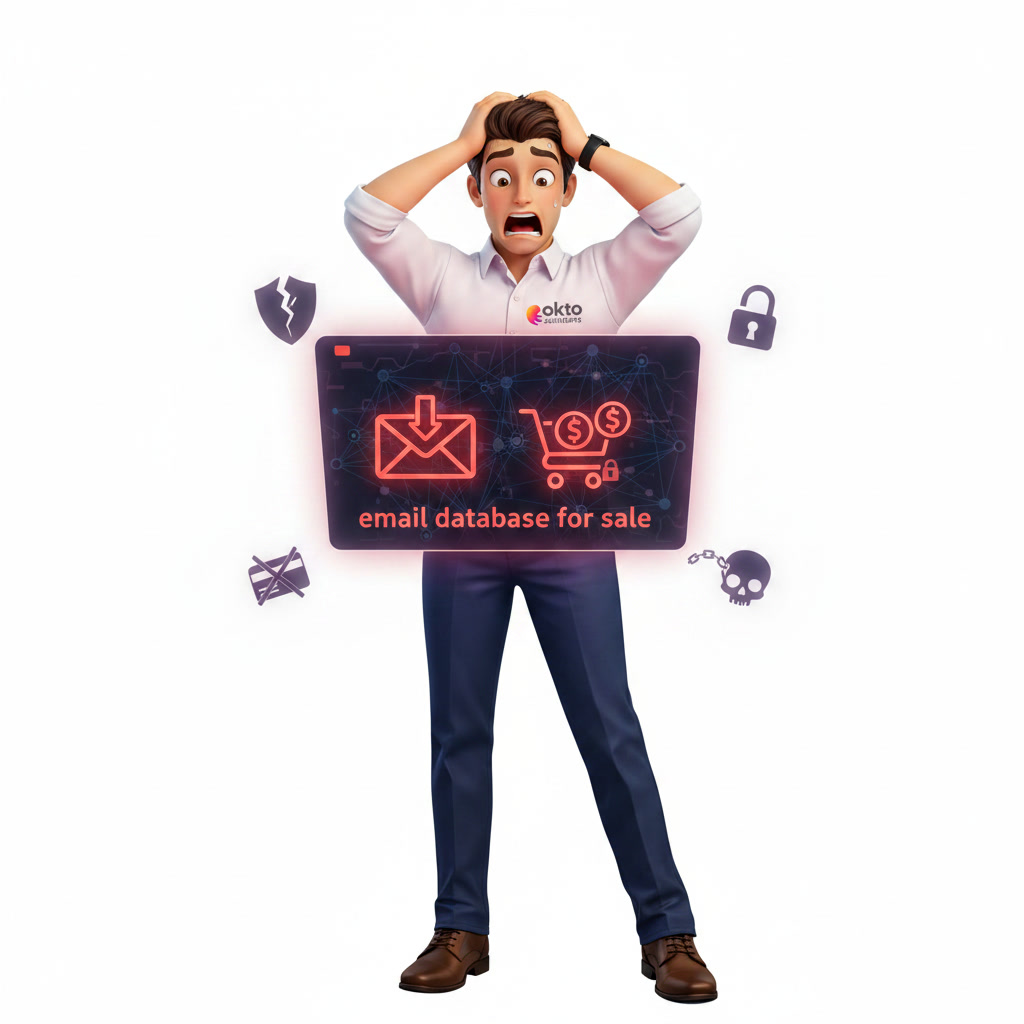
An employee receives a strange alert: their work email address is circulating on an obscure forum, along with a still-valid password. This is exactly the kind of scenario that plays out every week for small and medium-sized businesses in Trois-Rivières and the Mauricie region, often without anyone realizing it until it's too late. The dark web has become the black market for stolen credentials, and your company may already be listed there.
The good news is that we can investigate the situation, understand how these leaks occur, and implement concrete measures to limit the damage. This guide explains, in clear language, how to tell if your data is lurking on the dark web and what to do next.
Quick answer: To check if your data is on the dark web, use a monitoring tool that scans for known leaks based on your email addresses and domain name. If a match appears, immediately change the affected passwords, enable two-factor authentication, and monitor for suspicious logins. Continuous monitoring remains the only way to be alerted as soon as a new leak affects your business.
1. What is the dark web (and why does your data end up there)?
The web you use every day represents only a small part of the internet. Beneath the surface lies the dark web: a collection of sites accessible only through specialized software, designed to keep their visitors anonymous. Not everything there is illegal, but it's where most stolen data is bought and sold.
In practice, when a company is hacked, the stolen login credentials often end up for sale or freely accessible on these forums. These primarily include:
- Professional email addresses associated with passwords
- Login credentials for Microsoft 365, banks, or accounting software
- Personal information of customers or employees
- Card numbers and bank details
- Internal documents copied during a ransomware attack
For a hacker, this information is worth money. A single active password can serve as a gateway to your entire infrastructure, especially if the same password is reused across multiple services.
2. How your data ends up on the dark web
Data leaks almost never originate from targeted hacks specifically aimed at your SME. Most of the time, your credentials are leaked due to a more common vulnerability. Here are the most frequent sources.
- A leak at a third-party provider : if an online service that your employees use gets hacked, their emails and passwords end up in the wild.
- Phishing : an employee enters their credentials on a fake login page that looks like Microsoft 365 or your bank.
- Password reuse : a single password stolen elsewhere opens access to multiple professional accounts.
- Malware : a spy program installed on a computer captures everything that is typed on the keyboard.
- Ransomware attacks : before encrypting your files, hackers often copy them to exert pressure by threatening to publish them.
According to the Canadian Centre for Cyber Security, small and medium-sized enterprises (SMEs) are prime targets precisely because they have fewer resources to defend themselves. In Trois-Rivières, as elsewhere in Quebec, no SME is too small to be of interest to an attacker.
3. How to check if your data has been leaked
There are several ways to find out if your information is already circulating. From the simplest to the most comprehensive:
- Free verification tools : some online services allow you to enter an email address to see if it appears in known leaks. Useful for a quick check, but limited to one address at a time.
- Domain name monitoring : rather than testing each email one by one, a professional tool scans all addresses associated with your company domain.
- Continuous monitoring : a managed service that automatically alerts you as soon as a new leak affects your organization, without you having to think about it.
Spot checks have a significant limitation: they only show what has already been discovered. New leaks are constantly emerging, and a clean account today could be compromised tomorrow. That's why our managed IT services include continuous dark web monitoring, directly connected to your Microsoft 365 accounts and work email addresses.

4. What to do if your data is on the dark web
Discovering that your login credentials are circulating can be alarming, but it's not a disaster if you act quickly. Here are the steps to follow in order.
- Change the affected passwords immediately, as well as any accounts where the same password has been reused.
- Enable two-factor authentication wherever possible, starting with Microsoft 365 and financial access.
- Check recent connections : Microsoft 365 keeps a log of connections that reveals any activity from an unusual location or device.
- Notify affected individuals if customer or employee data is involved. In Quebec, this obligation is governed by Bill 25.
- Strengthen your team's phishing training , because the same method that caused the leak could strike again
A password found in a data breach should be considered public. Even if it hasn't yet been used by a hacker, it's only a matter of time. A quick response makes all the difference between a harmless scare and a costly incident.
5. How dark web monitoring protects your SME in Mauricie
A one-time check isn't enough. True protection comes from continuous monitoring, which detects leaks as they occur and allows you to react before a hacker can exploit your access. For a small business in the Mauricie region, this means sleeping soundly while a system watches over your accounts in the background.
A good approach combines dark web monitoring with strong password hygiene, two-factor authentication, and regular employee training. This combination transforms a weakness into a defensive reflex. If you are unsure of your current level of protection, please feel free to contact us for an initial assessment.
Frequently Asked Questions
How can I tell if my email address is on the dark web?
You can enter your address into a free leak detection tool for an initial overview. For a complete view of your entire business, domain name monitoring analyzes all your business addresses at once.
Is it dangerous to have your data on the dark web?
Yes, especially if an associated password is still active or reused elsewhere. An exposed username can be used to hack your accounts, but the risk drops significantly as soon as you change your password and enable two-factor authentication.
Can you have your data removed from the dark web?
No, once data is in circulation, it's impossible to erase it. The only effective response is to neutralize its value: change passwords, monitor access, and strengthen security so that the stolen information is useless.
Protect your data with an IT partner in Trois-Rivières
The dark web isn't going away, but your exposure can be managed with the right measures. Our team supports SMEs in Trois-Rivières and the Mauricie region by monitoring leaks, securing Microsoft 365, and building a robust defense. Discover our managed IT services or contact us through our contact page to assess your company's security.