By 2026, hackers are using artificial intelligence to strike faster, harder, and more convincingly. An AI-powered cyberattack on SMEs is no longer like those old, error-ridden emails. Today, AI generates perfect messages in your language, mimics your boss's voice, and automates thousands of attacks simultaneously. For Quebec SMEs, the danger is real and immediate.
At OKTO Solutions, we support SMEs in Trois-Rivières and the Mauricie region against these emerging threats. In this guide, we first explain how AI is transforming cyberattacks. Then, we detail the 5 most active new threats expected in 2026. Finally, we provide you with concrete actions to protect your business now.
Quick answer: By 2026, AI-powered cyberattacks will include hyper-personalized phishing, voice deepfakes, adaptive malware, and automated credential stuffing. Defenses will combine MFA, training, EDR, and sensitive request verification.
1. How AI is changing cyberattacks against SMEs in 2026
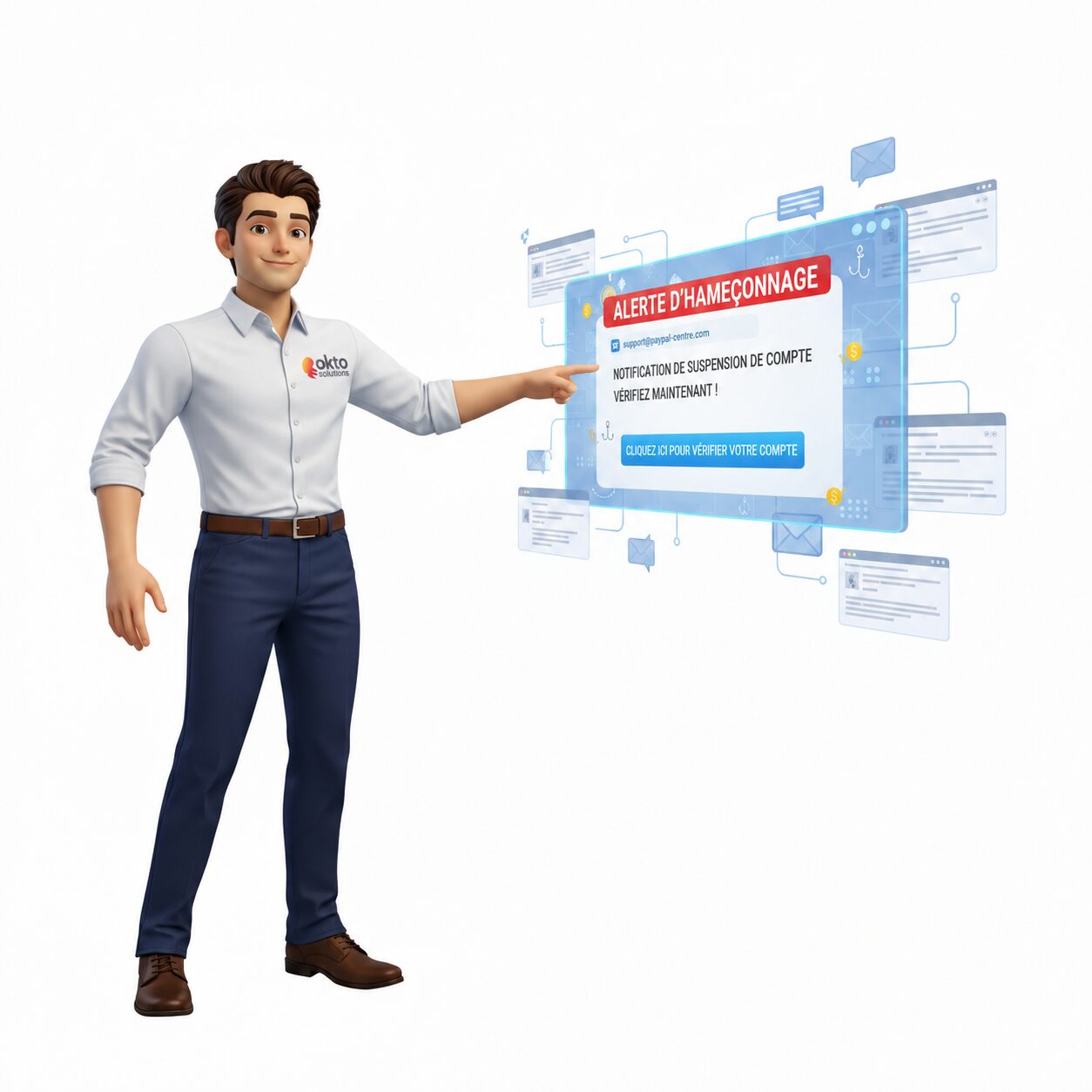
For years, companies recognized phishing attempts by their obvious grammatical errors. That's why this instinctive defense no longer works at all today. AI now generates impeccable, personalized texts with real details taken from LinkedIn or your website.
In concrete terms, an AI-driven cyberattack on SMEs in 2026 differs in three fundamental ways. First, it's fast: an attacker can launch thousands of personalized attempts in just a few hours. Second, it's credible: the message mentions your industry, your customers, and your exact name. Finally, it's automated: the AI adapts the attack in real time based on your responses.
2. The 5 most active AI cyberattacks targeting SMEs in 2026
1. Ultra-personalized AI phishing (AI spear phishing)
AI tools analyze your online presence, your LinkedIn posts, and your website. They then generate emails that appear to be written by someone who truly knows you. For example, an email might mention a recent project, a specific client, or an industry event. The Canadian Centre for Cyber Security confirms that phishing remains the number one entry point into corporate systems.
2. Voice and video deepfakes (CEO fraud)
AI can now clone a voice from just a few seconds of recording. This type of AI-powered cyberattack targeting small and medium-sized businesses (SMBs) is rapidly gaining ground in Quebec. As a result, criminals are imitating the CEO's voice to request an urgent wire transfer from a finance employee. This AI-powered cyberattack specifically targets small businesses where staff trust management without a verification protocol. Cases have already been reported in Quebec.
3. AI-written malware (AI malware)
AI can write malicious code in minutes. However, the danger doesn't just stem from the speed of creation. This malware adapts to evade traditional antivirus software because it's generated with unique variations for each attack. That's why signature-based detection solutions alone are no longer sufficient.
4. Automated credential stuffing attacks
AI tests millions of stolen password combinations against your online accounts. Furthermore, it automatically identifies the most important accounts to target: the CEO's email, accounting access, and the Microsoft 365 admin portal. For SMEs that reuse the same passwords, the risk is critical. See our article on email protection against phishing to understand how to protect your access.
5. AI social engineering via Teams and LinkedIn
Attackers are now directly targeting Microsoft Teams and LinkedIn with fake but credible AI-generated profiles. They first establish a genuine professional relationship. Consequently, when they request sensitive information or access, the victim naturally trusts them.
3. Facing an AI cyberattack on SMEs: the 6 essential protections in 2026
The good news is that effective protections exist. However, they must be adapted to this new AI reality. Here's what we recommend to our clients in the Mauricie region.
Multi-factor authentication (MFA) on all accounts
MFA blocks over 99% of automated attacks on accounts, even if the password is stolen. Notably, Microsoft reports that accounts with MFA enabled resist credential stuffing attacks in the vast majority of cases. It's the number one, fastest to implement, and most effective security measure.
Ongoing training for your team
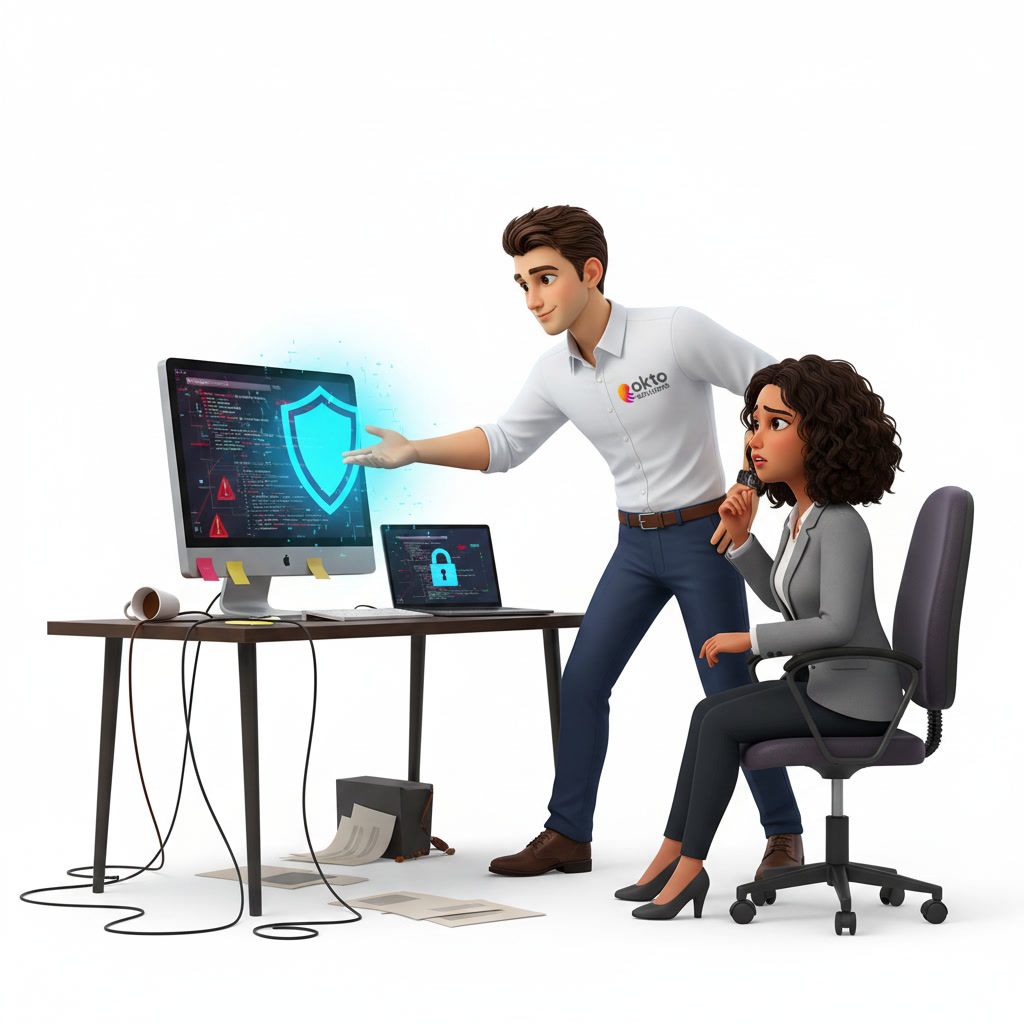
When facing an AI cyberattack on an SME, your first line of defense remains your staff. Indeed, an employee who recognizes a suspicious email or an unusual urgent request can prevent a complete disaster. However, training must be regular, not just a single annual workshop. Attacks evolve every month.
A modern EDR (Endpoint Detection and Response)
Faced with an AI-driven cyberattack on SMEs, traditional antivirus software no longer detects AI-generated malware. In contrast, EDR solutions analyze program behavior rather than signatures. Thus, they detect suspicious activity even if the code is unknown. This is the standard we are seeing among our clients in Trois-Rivières.
A verification protocol for urgent requests
CEO fraud using voice deepfakes can be countered with a simple protocol. For example, any wire transfer request exceeding a certain amount requires confirmation via a second channel. However, this protocol must be known to all finance staff. OKTO Solutions can help you implement it.
24/7 monitoring of your Microsoft 365 environment
The majority of AI-driven cyberattacks targeting small and medium-sized businesses (SMBs) in 2026 will primarily target Microsoft 365. Furthermore, they often occur at night or on weekends. This is why continuous monitoring of your Microsoft 365 tenant detects abnormal connections and lateral movement before they cause damage. Discover our Microsoft 365 monitoring services for SMBs.
Isolated backups that are regularly tested
If an attack succeeds despite everything, recent and isolated backups limit the damage. Consequently, ransomware cannot encrypt your backup copies if they are located in a separate environment. Our article on disaster recovery planning for SMEs explains how to structure this protection.
Frequently asked questions about AI cyberattacks for SMEs
Is a small business in Trois-Rivières really being targeted by an AI cyberattack?
Absolutely. AI attacks are automated and don't discriminate based on size or region. Indeed, a small or medium-sized enterprise (SME) in Quebec represents an attractive target precisely because it has data and financial resources, often with less protection than a large corporation. Attackers seek the path of least resistance.
Is MFA sufficient against AI cyberattacks on SMEs?
MFA is essential, but it's not enough on its own. In particular, some advanced attacks bypass MFA using fatigue techniques (sending dozens of notifications until the employee mistakenly accepts). This is why a layered approach remains necessary: MFA + EDR + training + monitoring.
How much does protection against AI cyberattacks cost?
The cost of protecting your small or medium-sized business (SMB) against an AI cyberattack is always less than the cost of a successful attack. However, fees vary depending on the size of your company and the level of protection required. OKTO Solutions offers packages tailored to SMEs in the Mauricie region. Contact us for a free evaluation.
Protect your SME against AI cyberattacks in 2026
The AI cyberattacks targeting SMEs in 2026 represent the biggest shift in the threat landscape in years. Therefore, waiting for something to happen is not a strategy. At OKTO Solutions, we assess your current situation and implement protections tailored to your specific needs as an SME in Trois-Rivières and the Mauricie region.
Contact our team for a free security assessment or discover our cybersecurity services for SMEs in Quebec.