AI cyberattacks on small business in 2026: 5 new threats and how to defend

In 2026, attackers use artificial intelligence to strike faster, harder and far more convincingly. An AI-powered cyberattack no longer looks like the old email full of spelling mistakes. Today, AI writes flawless messages in your language, imitates your boss’s voice and automates thousands of attacks at once. For Quebec small businesses, the danger is real and immediate.
At OKTO Solutions, we support small businesses in Trois-Rivières and the Mauricie against these emerging threats. In this guide, we first explain how AI is changing cyberattacks. Then we go through the 5 most active new threats in 2026. Finally, we give you concrete steps to protect your company starting now.
Quick answer: In 2026, AI-boosted cyberattacks include hyper-personalized phishing, voice deepfakes, adaptive malware and automated credential stuffing. The defence combines MFA, training, EDR and verification of sensitive requests.
1. How is AI changing cyberattacks against small businesses in 2026?
For years, companies spotted phishing attempts by their obvious spelling errors. That instinctive defence no longer works at all. AI now writes flawless text, personalized with real details pulled from LinkedIn or your website.
In practice, an AI-powered attack on a small business in 2026 differs on three fundamental points. First, it is fast: an attacker can launch thousands of personalized attempts in a few hours. Second, it is credible: the message names your industry, your clients and your exact name. Third, it is automated: the AI adapts the attack in real time based on your replies.
Key figure: According to the Canadian Centre for Cyber Security, Canadian small businesses are increasingly targeted by automated attacks. Small businesses are a preferred target because they hold valuable data with fewer protections than large companies.
2. The 5 most active AI cyberattacks on small businesses in 2026
1. Hyper-personalized AI phishing (AI spear phishing)
AI tools analyze your online presence, your LinkedIn posts and your website. From that, they generate emails that read as though written by someone who genuinely knows you. A message might mention a recent project, a specific client or an event in your sector. The Canadian Centre for Cyber Security confirms that phishing remains the number one way into corporate systems.
2. Voice and video deepfakes (CEO fraud)
AI can now clone a voice from a few seconds of recording. This form of attack spreads fast because it takes so little to pull off. Criminals imitate the chief executive’s voice to ask a finance employee for an urgent wire transfer. It specifically targets small companies where staff trust management with no verification protocol.
3. Malware written by AI
AI can write malicious code in minutes. The danger, though, is not only the speed of creation. This malware adapts to slip past traditional antivirus, because it is generated with unique variations for each attack. That is why detection based on signatures alone no longer suffices.
4. Automated credential stuffing attacks
AI tests millions of stolen password combinations against your online accounts. It also automatically identifies the most valuable accounts to target: the director’s email, accounting access, the Microsoft 365 administrator portal. For small businesses that reuse the same passwords, the risk is critical. Our article on protecting email against phishing explains how to secure your access.
5. AI social engineering through Teams and LinkedIn
Attackers now go straight at Microsoft Teams and LinkedIn with fake but credible profiles generated by AI. They first build a genuine professional relationship. So when they ask for sensitive information or access, the victim trusts them naturally.

3. Facing an AI cyberattack: the 6 essential protections in 2026
The good news is that effective protections exist. They do have to be adapted to this new AI reality. Here is what we recommend to our clients in the Mauricie.
Multi-factor authentication (MFA) on every account
MFA cuts the risk of account compromise by 99.22 percent, and by 98.56 percent even when the password has already leaked (Microsoft research, 2023). It is measure number one, the fastest to put in place and the most effective.
Ongoing training for your team
Against an AI-powered attack, your first line of defence is still your people. An employee who recognizes a suspicious email or an unusual urgent request can prevent a complete disaster. The training has to be regular, though, not a single workshop once a year. The attacks change every month.
A modern EDR (Endpoint Detection and Response)
Traditional antivirus no longer detects AI-generated malware. EDR solutions analyze how programs behave rather than what they look like. They flag suspicious activity even when the code is unknown. That is the standard we deploy for our clients in Trois-Rivières.
A verification protocol for urgent requests
CEO fraud through a voice deepfake is countered with a simple protocol. Any transfer request above a set amount requires confirmation through a second channel. That protocol has to be known by every member of the finance team. OKTO Solutions helps you put it in place.
Round-the-clock monitoring of your Microsoft 365 environment
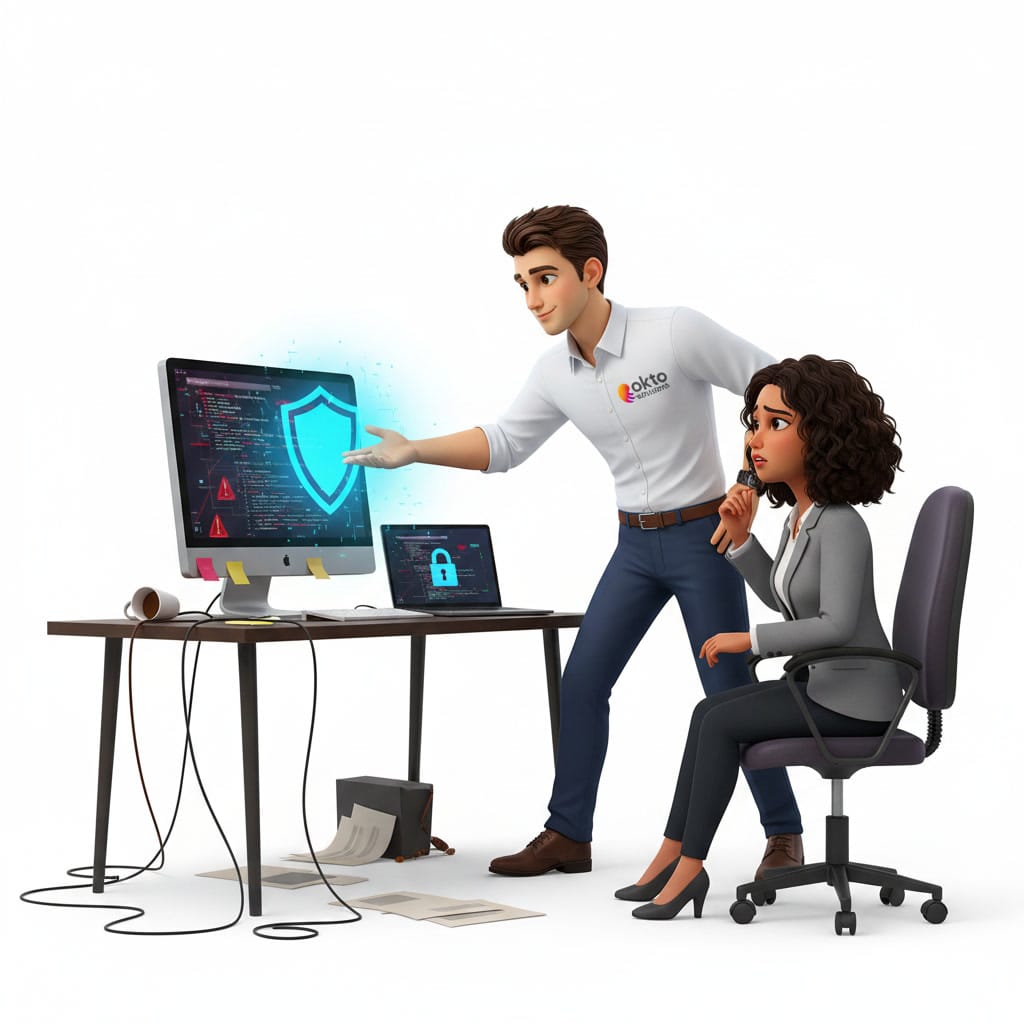
Most AI-powered attacks on small businesses in 2026 aim at Microsoft 365 first. They also tend to happen at night or on weekends. Continuous monitoring of your Microsoft 365 tenant catches abnormal sign-ins and lateral movement before they cause damage. Have a look at our Microsoft 365 monitoring services for small business.
Isolated backups, tested regularly
If an attack succeeds anyway, recent isolated backups limit the damage. Ransomware cannot encrypt your backup copies when they sit in a separate environment. Our article on disaster recovery planning for small businesses explains how to structure that protection.
Frequently asked questions about AI cyberattacks on small businesses
Is a small business in Trois-Rivières really targeted by AI attacks?
Absolutely. AI attacks are automated and make no distinction by size or region. A Quebec small business is an appealing target precisely because it has data and money, often with fewer protections than a large company. Attackers look for the path of least resistance.
Is MFA enough against AI cyberattacks?
MFA is essential, but not sufficient on its own. Some advanced attacks work around MFA with fatigue techniques, sending dozens of notifications until an employee accepts one by mistake. That is why a layered approach stays necessary: MFA plus EDR plus training plus monitoring.
How much does protection against AI cyberattacks cost?
Protecting against an AI-powered attack always costs less than a successful attack. Fees vary with the size of your company and the level of protection required. OKTO Solutions offers packages suited to small businesses in the Mauricie. Contact us for an assessment at no cost.
Protect your business against AI cyberattacks in 2026
AI cyberattacks in 2026 represent the biggest shift in the threat landscape in years. Waiting for something to happen is not a strategy. At OKTO Solutions, we assess where you stand and put protections in place suited to the reality of a small business in Trois-Rivières and the Mauricie.
Contact our team for a no-obligation assessment of your security or explore our cybersecurity services for small businesses in Quebec.
Sources:
Canadian Centre for Cyber Security: tips for small businesses
Microsoft Learn: anti-phishing protection in Microsoft 365
Microsoft Learn: how multi-factor authentication works
Reading about AI is one thing. Connecting it to your own data is another: artificial intelligence in business, custom AI application development and our IT services in Quebec City.