
Trois-Rivières, serving all of Quebec 450 231-3836 info@oktosolutions.ca
FR

vCIO module

vCIO in Quebec: outsourced IT director, IT master plan and roadmap for SMBs

An IT director, without hiring an IT director. The vCIO module from OKTO Solutions gives you a named IT advisor who builds your IT master plan, plans your technology budget and prioritizes your projects with you, on a meeting schedule set in advance.

A vCIO, or virtual CIO, is a shared technology advisor who takes the long view of a small business’s IT: master plan, roadmap, budget, project priorities and risk. At OKTO Solutions it is a paid module added to a managed IT services plan, starting at ten workstations or servers.

In short

What is the vCIO module, and who is it for?

The vCIO module gives a company a named IT advisor who knows the file: the equipment, the contracts, the projects and the constraints. That advisor builds the master plan, keeps the roadmap current, plans the technology budget and settles priorities with management. It suits organizations of ten workstations or more whose leadership has to make technology calls with nobody in house to advise them, and those whose IT spending gets decided case by case, usually right after something broke. What changes is the order of the decisions: they get planned instead of endured.

  • One point of contact, who does not need your company explained again at every meeting
  • A risk review that names the fragile dependencies: a single server, an irreplaceable vendor, a backup nobody has tested, a shared administrator account
  • Fixes proposed in a realistic order, not a wish list
The advisor knows your file. That is half the value of the module.
  • Translation between the business goal and the technical project, in both directions
  • A plan lined up with Quebec’s Law 25 and with what your customers require
A module, not a plan: the vCIO sits on top of a managed IT services plan and is never bundled in by default. It comes in three levels, Essentiel, Standard and Stratégique, which are not to be confused with the Base, Standard and Complet plans. Two separate line-ups.

The rhythm

What does a vCIO actually do over a year?

The question comes up at every first meeting, and it is a fair one: a strategic advisor is harder to see at work than a technician fixing a printer. Here is how a real mandate runs, from the first month to the point where the cycle starts over. The first two months are for documenting and writing. The rest of the year follows a schedule set in advance, with meetings on the calendar rather than at the mercy of whatever is on fire.

  1. Month 1: the starting picture

    We document what you have: equipment, licences, contracts, vendors, security, backups and dependencies. Above all we listen to your business goals for the next few years, because that is where the technical priorities come from.

  2. Month 2: the IT master plan

    The master plan puts the current state, the risks, the gaps and the ranked priorities in writing. It is the reference document we come back to at every meeting, instead of starting from a blank page each time.

  3. Month 3: roadmap and budget

    Projects are ordered in time and sized in effort, with the budget planning that goes with them. The horizon runs from 12 to 36 months depending on the level. You know what is coming and when to set money aside for it.

  4. Every quarter or half-year: strategic review

    Twice a year at the Standard level, quarterly at the Stratégique level. The meeting covers progress, the incidents that happened, the risks and the priorities for the period ahead. Recommendations are written down, not just said out loud.

  5. Four times a year: phishing simulation

    One campaign per quarter, at all three levels. The results are used to aim the security awareness training where it is missing, never to point fingers.

  6. Ongoing: revising the plan

    A move, an acquisition, a customer requirement or an incident changes the priorities. The roadmap follows those changes instead of sleeping in a drawer until the next crisis.

At the Essentiel level, the master plan and the basic roadmap are included; the strategic review meetings are then billed as used.

Three levels

Comparing the Essentiel, Standard and Stratégique levels

The level is chosen for the depth of advice you want, not for the size of the company. All three require a minimum of ten workstations or servers and are billed per workstation or per server. Four things separate them: the number of hours included, the depth of the roadmap, how often the strategic reviews happen and access to the business AI platform. The master plan, the documented recommendations and the four phishing simulations per year are there at all three levels.

What is included Essentiel Standard Stratégique
Hours included per year, per workstation or server 4 h 6 h 8 h
IT master plan Included Included Included
Roadmap Basic 12 months Advanced
Strategic review meetings Billed as used Twice a year Quarterly
Phishing simulations, 4 per year Included Included Included
Documented recommendations Included Included Included
Vendor management Billed as used Billed as used Billed as used
Project management Billed as used Billed as used Billed as used
Attendance at your business meetings Billed as used Billed as used Billed as used
Business AI platform No Included Included
Minimum workstations or servers 10 10 10

Master plan and roadmap

What is an IT master plan, and what is the roadmap for?

The IT master plan describes the current state of your environment, the risks, the gaps that were found and the priorities in ranked order. The roadmap then places those priorities in time, along with what each one means for the budget. One says where you are, the other says in what order you move forward. Both are working documents revised at every meeting, not reports filed in a drawer after the presentation.

The master plan contains

  • An inventory of the equipment, licences, contracts and vendors
  • The state of security, backups and privileged access
  • The fragile dependencies, and what happens when one of them gives out
  • The gaps against your obligations and against what your customers require
  • The ranked priorities, with the reasoning behind the ranking

The roadmap adds

  • Projects ordered over a 12 to 36 month horizon depending on the level
  • The effort estimated for each one, and what to set aside in the budget
  • The business goal each project is attached to
  • What is waiting, and why it is waiting, written down in plain words
  • Revision as things change: a new location, an acquisition, a customer requirement

Budget planning

How does a vCIO make the IT budget predictable?

A company with no technology planning spends in jolts. A server dies in July, so the money has to be found in July. A licence renews without anyone having seen it coming. The advisor’s job is to place those deadlines in time: hardware life cycle, contract renewals, planned projects, replacements spread over several fiscal years. Spending then lands when it was planned for, which makes the year easier to budget and makes the conversation with management a lot shorter.

  • Equipment life cycle, with replacements spread across several fiscal years
  • Licence and contract renewals put on the calendar

Projects get ordered by risk and business goals, not by whichever vendor called last.

Antonio Pazzi, founder of OKTO Solutions
  • Projects sized in effort before they are proposed for the budget
  • Investments ranked by risk and by business goal
  • Trade-offs documented, so the decision still holds up when you reread it six months later

Vendors

Who talks to your technology vendors?

In a lot of small companies the answer is "whoever has time", and it is never the same person twice. The result: contracts that renew on their own, a line-of-business application whose exit terms nobody knows, an internet provider who only gets called during an outage. Vendor management means carrying those conversations for you, with the technical vocabulary and the history in hand. It is billed as used at all three levels, because the volume varies enormously from one organization to the next.

  • Tracking of contracts, renewal dates and exit terms
  • Technical exchanges with the vendor of your line-of-business software
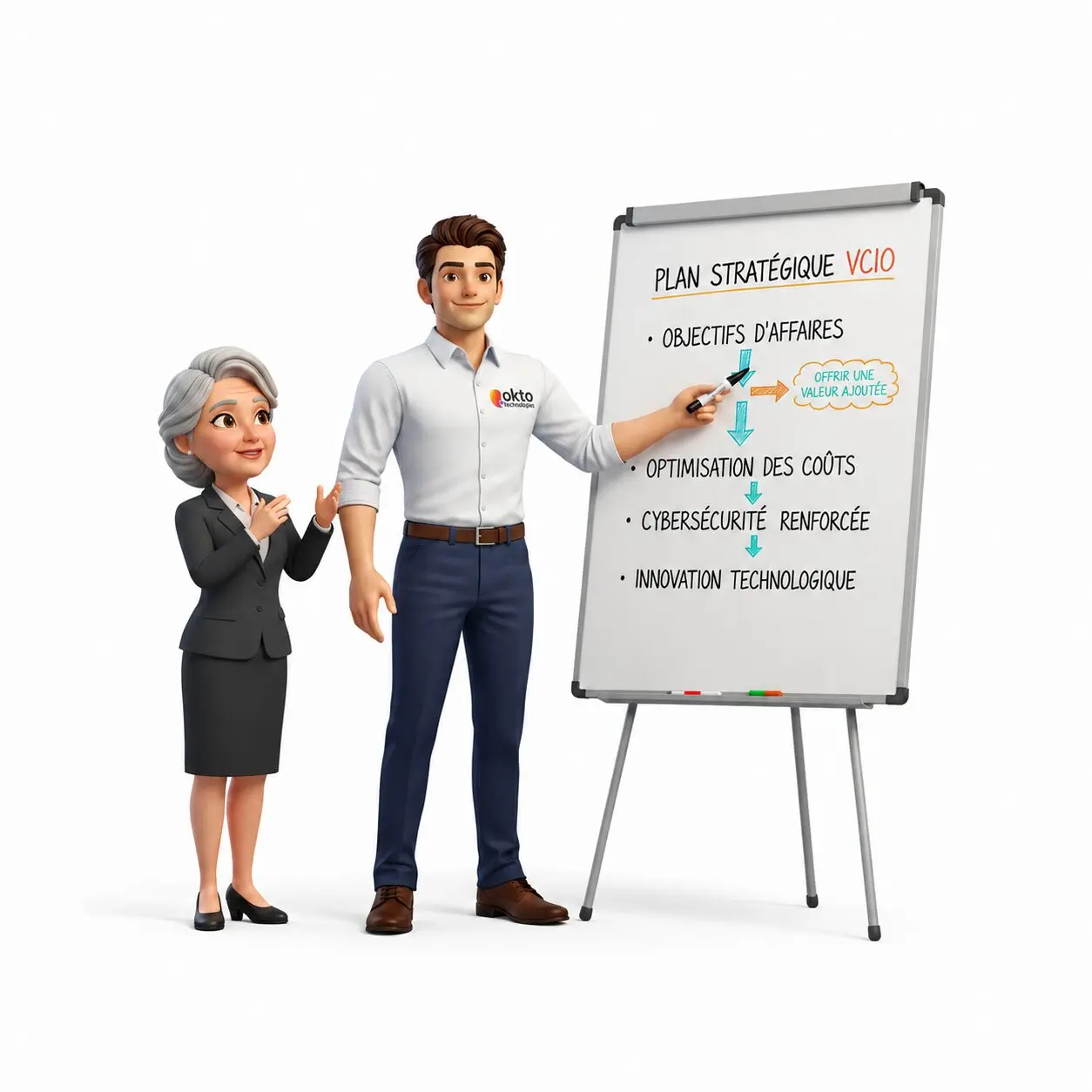
A vCIO advisor presenting a strategic plan on a flip chart to a client
A file kept up to date beats a good memory, especially at renewal time.
  • Comparison of offers when a renewal is coming up
  • Coordination when you change vendors, with no break in service
  • Project management on larger jobs, also billed as used

Awareness

Why four phishing simulations a year?

Because one campaign a year measures a single day, not a habit. Four simulations spread across the year give you a trend: are people clicking less, are they reporting more, does one department need a hand. All four campaigns are included at every level of the module, Essentiel included. The results are used to aim the security awareness training, never to name publicly who clicked, which is the surest way to make the reports stop coming in.

Awareness rounds out the technical work described in our managed cybersecurity service: the tools block most of the messages, the employees catch the rest.

  • Four campaigns a year, one per quarter, at all three levels
  • Scenarios built around your industry and your real processes
  • Click rate and reporting rate tracked over time
  • Security awareness training aimed where the results say it is needed
  • Results kept on file, useful in front of an insurer or a demanding customer

Compare

vCIO module, in-house IT director, or no planning at all

Three ways to steer the technology strategy of a small business. Here is what separates them in practice.

The vCIO module

A module added to your plan, from ten workstations or servers up. Behind the advisor sits a team that sees dozens of different environments. The master plan is included at all three levels, and the documentation stays with you even if the person changes.

An in-house IT director

An executive position, with the salary, the benefits and the training that come with it. The experience is that of one person, and their departure often takes the memory of your decisions along. It is an excellent choice once the organization is large enough to justify it.

No formal planning

No financial commitment, right up until the first incident. Decisions get made under pressure, using whatever the last vendor said. The IT budget gets discovered on the day it has to be spent.

The vCIO does not replace your internal team when you have one. It gives that team a framework, a plan and a counterpart at the same level to settle priorities with, the way our co-managed IT services work. The module is available across Quebec: see our IT services in Trois-Rivières and our IT services in Laval. Governance rests on execution, and execution lives in our managed IT services.

Questions and answers

Common questions about the vCIO module

What is a vCIO?
A vCIO, short for virtual chief information officer, is a part-time IT director for your company. The role plans your technology strategy, structures your IT budget and lines your tools up with your business goals, without you having to hire an executive full time.
What is the difference between a vCIO and technical support?
Technical support fixes the day-to-day: a workstation that will not boot, a full mailbox, a printer gone quiet. The vCIO works a level above: planning, prioritizing and guiding the decisions that play out over the next one to three years. Both are useful, and neither replaces the other.
Is my company big enough for a vCIO?
The module requires a minimum of ten workstations or servers. From there, the Essentiel level gives you the IT master plan and a basic roadmap, which is enough to get out of deciding technology one crisis at a time.
What is the difference between the Essentiel, Standard and Stratégique levels?
All three include the IT master plan, the documented recommendations and the four phishing simulations per year. They differ on the number of hours included, the depth of the roadmap (basic, 12 months or advanced), how often the strategic review meetings happen (billed as used, twice a year or quarterly) and access to the business AI platform. The table on this page compares them line by line.
Does the vCIO attend our business meetings?
Yes, that is available at all three levels and billed as used. Some organizations bring their advisor to board or management committee meetings when a technology investment is on the agenda.
What is in an IT master plan?
The current state of your environment, the risks and gaps that were found, the priorities in ranked order, and the roadmap that places projects in time along with what each one means for the budget. It is a working document that gets revised, not a report that gets filed.
Do I have to be a managed services client already?
Yes. The vCIO module is designed to sit on top of a managed IT services plan, and it is never bundled in by default. That is what gives the advisor the data the role needs: an inventory of the fleet, the incidents, the patching, the state of the backups. Without that data, planning rests on what people say rather than on what is actually there.

Have your IT master plan built

Tell us about your goals for the next few years and about what worries you in your IT. We will tell you which level of the module fits, no strings attached.