

Antonio Pazzi
President and founder
The direction of the company, the commitments made to clients and the files that need somebody to decide. He also signs the technical articles published on this site.
Our team
This page says who works at OKTO Solutions, who is responsible for what, and what actually happens when you pick up the phone.
The OKTO Solutions team is split across five functions: leadership, solutions architecture, operations and client service, sales and business development, and automation and software development. The office is in Trois-Rivières and the service covers all of Quebec, in French and in English.

The people
A small business does not need our org chart. It needs to know who a given decision belongs to.
President and founder
The direction of the company, the commitments made to clients and the files that need somebody to decide. He also signs the technical articles published on this site.

Solutions architect
The design of whatever gets put in place: infrastructure, Microsoft 365 environment, network, security, migrations. He decides how a thing should be built before anyone installs it.

Director of operations & Client service
The day to day: taking in requests, following up on the work, coordinating projects and keeping the relationship with you. She is the person who knows where your file stands.

Automation and business development specialist
The tools built in house and the automations installed at client sites. This work is the reason we do not carry the limits of a provider reselling somebody else’s software.
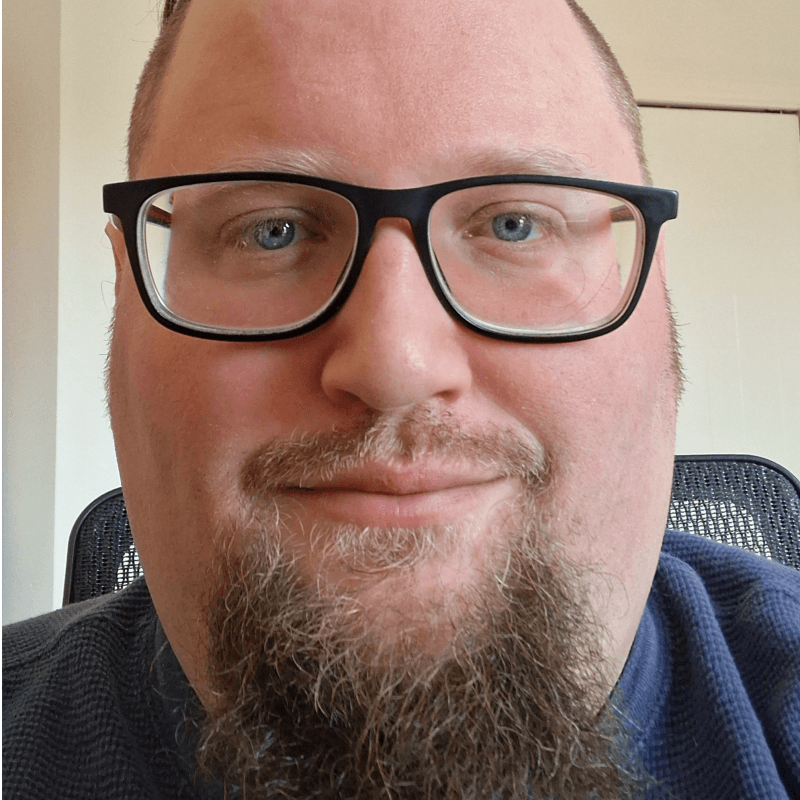
Business development representative
The first meetings, the inventory of what is already there and the building of proposals. He also stays on through the transition away from your previous provider.

Sales director | Organizational development
The commercial relationship and the growth of the company, from first contact through to the service agreement. She also looks after how the team is organized internally.
Who does what
Five functions genuinely exist at OKTO Solutions, and each one answers for something specific. Leadership carries the direction of the company and settles what has to be settled. Solutions architecture designs before anything gets installed. Operations takes in requests and follows the work through. Sales meets you, inventories what you run and builds the proposals. Automation develops the tools we use internally and the automations installed at client sites. So when a decision concerns you, you know which function it belongs to, and the operations team tells you who is carrying it.
The direction, the commitments made to clients and the calls that belong to nobody else. It is also the function that answers when a file needs a decision made on it.
Infrastructure, Microsoft 365 environment, network, security, migrations. Design comes before installation, and it is written down somewhere before a single cable gets plugged in.
Taking in requests, following the work, coordinating the projects under way. This is the function that knows where your file stands at any given moment.
The first meetings, the inventory, the proposals and the support during the transition away from your old provider. The method is laid out on the page explaining how we build a quote.
The tools built in house, OKTO RMM, OKTO PSA, OKTO Sign and OKTO Flux, and the automations installed at client sites. That is what keeps us from waiting on somebody else’s vendor.
Your company has a file with us, not a place in a queue. The history of your equipment, the decisions taken and the documented access stay available, even when the person answering changes.
How a request travels
You do not land in an anonymous queue. The request is logged in our own ticketing tool, attached to your company and to the device involved, and you get the name of the person who took it. The first sort separates what stops a business from what annoys one person: a full outage comes before a blocked group, which comes before a single user, which comes before a routine request. That order is the same for every client and it does not depend on the size of the plan.
A request climbs a level when it leaves the scope of the level it is in, not after a fixed number of minutes. The technician who escalates passes along everything already tried. You have nothing to explain twice.
Most of the work is settled remotely, with nobody having to drive anywhere.
| Level | Who handles it | Typical requests | What triggers the escalation |
|---|---|---|---|
| Level 1 | IT specialist, front line | Access, password, email, printing, slow workstation | The problem hits more than one person or keeps coming back |
| Level 2 | IT specialist, analysis | Application incident, licensing, network behaviour, compromised workstation | The cause sits on the server, the network or in the cloud |
| Level 3 | Systems administrator | Server, Azure, firewall, restore, security | A component has to be changed or replaced |
| Project | Solutions architecture | Migration, new server, network rebuild | The change is planned with you, never improvised |

Our tools
Fleet monitoring, tickets, time, assets and document signing all run through tools built here rather than rented from a vendor. That changes two things for you. The history of your equipment stays here and stays available to you. And when a feature is missing, we add it instead of writing to a supplier who may or may not put it on a roadmap.
More than 15 years of combined experience, more than 100 organizations supported and a 5.0 rating across 34 public Google reviews. Those numbers are broken down, with what each one means and where it comes from, on the OKTO Solutions by the numbers page.
Questions and answers
It is still to talk to us. We answer the questions, look at your situation, and tell you plainly whether we are the right provider for you. The first meeting commits you to nothing.
We use cookies that are strictly necessary for the site to work. Only with your consent do we add measurement cookies that tell us which pages get read. Refusing costs you nothing, and you can change your mind at any time from the bottom of any page. Cookie details.
 OKTO PSA · Service desk