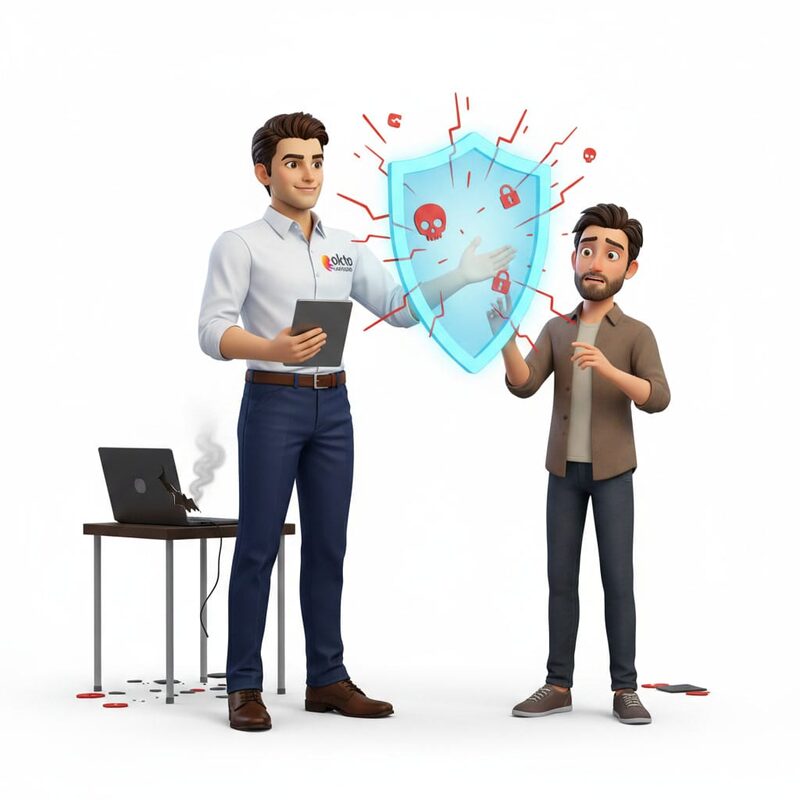
Why Anthropic Keeps Claude Mythos Under Wraps

Usually, when a company builds a landmark product, it hurries to sell it. Anthropic did the opposite with Claude Mythos: its most gifted artificial intelligence when it comes to security is the one model the company decided not to release publicly. A rare choice, almost counterintuitive, and it says a lot about how capable this AI really is.
Why keep such a high-performing tool under lock and key? The answer is both fascinating and reassuring. Here it is, explained simply.
Quick answer: Anthropic is not making Claude Mythos public because its cybersecurity and biology capabilities are advanced enough to be turned against us, for example to build cyberattacks. The model is reserved for a small group of vetted partners. For the general public, Anthropic released Fable 5 instead, a version fitted with guardrails that block dangerous uses.
1. Power that cuts both ways
Claude Mythos is exceptionally good at finding security flaws. That is exactly what makes it delicate. The same talent that helps protect software could, in the wrong hands, be used to attack it.
Anthropic said it plainly: the model’s capabilities in cybersecurity and biology are advanced enough to be misused, to the point of making cyberattacks or other dangerous work easier. Faced with that risk, the company chose caution over a race to launch.

2. Reserved for vetted partners
Instead of a conventional launch, Mythos is handed to a small circle of trusted organizations. The goal is not to sell, but to secure the world’s most critical software before criminals get there first.
- Access limited to carefully selected partners.
- Supervised use, aimed at defence and at fixing flaws.
- A stated intention to widen access later, carefully.
3. Fable 5: the public, safeguarded version
Anthropic did not want to keep this new generation of intelligence away from everyone. The answer: build Fable 5, a model in the same class but fitted with guardrails that cap its performance in high-risk areas. The result is that the public gets a very capable AI, without the dangerous part.
It is a good example of responsible deployment: keep the useful power, take away the risky power.

4. Why this choice is reassuring
Watching a company deliberately slow the release of such a capable technology is rare, and rather healthy. It shows that safety is being taken seriously at the source, before the product ever reaches the market.
For businesses, the message is clear: the race for raw power now comes with a race for responsibility. And that is a good thing.
Frequently asked questions
Why is Claude Mythos not public?
Because its cybersecurity and biology capabilities could be turned to malicious ends. Anthropic prefers to reserve it for vetted partners.
Who can access Claude Mythos?
Only a small group of trusted organizations selected by Anthropic, with the stated intention of opening access more widely in the future.
How can the general public benefit from it?
Through Fable 5, a model of the same class but safeguarded, which blocks high-risk uses while keeping a large share of the power.
IT support that puts security first
The leading names in AI are putting safety at the centre of their decisions. Your business deserves the same approach. Take a look at our IT services or contact OKTO Solutions in Trois-Rivières to talk it over.
Sources: Anthropic · Axios · CNBC · OKTO Solutions
Reading about AI is one thing. Connecting it to your own data is another: artificial intelligence in business, custom AI application development and our IT services in Quebec City.